ODB Database Viewer Online Tutorial

This is a simple tutorial for ODB Database Viewer users. It covers the following topics: which database formats are supported? how do I create a new database? How do I open an existing database file? What basic database operations can I do? How do I connect to MySQL or other databases stored on a server?

Sponsored Links

ODB Database Viewer not only enables you to create and manage local databases (.odb), but also allows you to connect to and manage almost all popular database engines: MySQL/MariaDB, MS Access, PostgreSQL, Oracle, MS SQL Server, and more.
Compatibility

ODG Database Viewer is totally compatible with OpenOffice and LibreOffice.

Which Database Formats Are Supported?

HSQLDB Embedded (.odb) – a SQL relational database system written in Java. This is the default database type when you create a new database in ODB Database Viewer.

Via ODBC and JDBC drivers, you can connect to and manage almost all popular database engines: MySQL/MariaDB, MS Access, PostgreSQL, Oracle, MS SQL Server, and more.

Note: if you use the default HSQLDB Embedded database (.ODB file), you need to install Java (JRE/JDK) on your PC. You can find the detailed instructions here.

How Do I Create a New Database?

HSQLDB is an open-source relational database software written in Java. It conforms to the SQL:2011 standard and JDBC 4 specifications. HSQLDB can store data in memory or on disk. HSQLDB is perfect for small database applications.

Sponsored Links

By default, ODB Database Viewer creates new databases using the HSQLDB Embedded database.

Step 1 – you can start creating a new database using one of the following ways:

  • Use File > New on the Menu bar and select Database from the context menu.
  • Use the keyboard shortcut Ctrl+N to create a new Database. 

  • Click the New icon on the Standard toolbar.

Step 2 – In the Wizard, select “Create a new database” and click the button “Next”.

Step 3 – in the step “Save and proceed”, keep all the default options and click the button “Finish”.

Step 4 – give the new database a name and click the button “Save”.

Now you have a new database open for you to edit.

How Do I Open an Existing .ODB Database File?

In ODB Database Viewer, you can open a .odb database file in one of the following ways:

Sponsored Links
  • Use File > Open on the Menu bar and select the database file from the window.
  • Use the keyboard shortcut Ctrl+O to open a document. 

  • Click the Open icon on the Standard toolbar.
  • Click on the small triangle to the right of the Open icon on the Standard toolbar and select the type of document from the context menu that opens.


After the database is open in ODB Database Viewer, you can edit it now.

What Basic Database Operations Can I Do in ODB Database Viewer?

A database consists of a number of fields that contain the individual pieces of data.

Sponsored Links

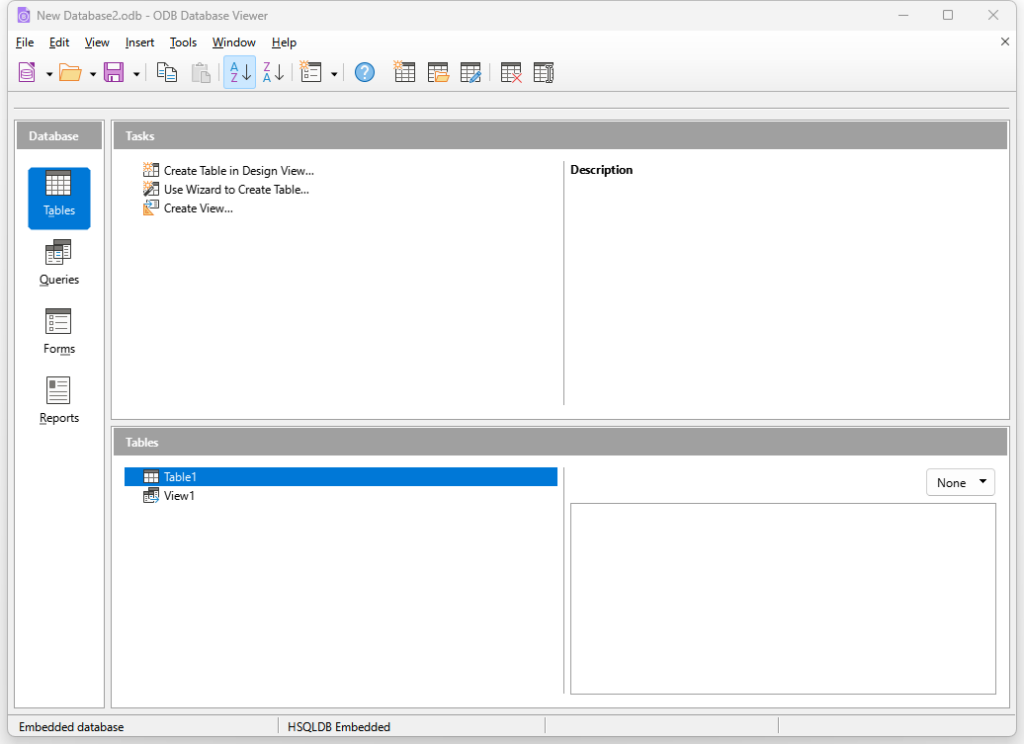
ODB Database Viewer provides four components to manage a database. They are tables, queries, forms and reports.

Tables

Each table of the database is a group of fields. Each field of a table contains information of a single type. To work with tables, click the “Tables” icon in the “Database” list and then select one of the three tasks in the “Tasks” list. 

Queries

Queries are used to get specific information from a database. Query results are special tables within the database. To work with queries, click the “Queries” icon in the “Database” list and then select one of the three tasks in the “Tasks” list. 

Forms

Forms are used to put the data into the database. In the language of databases, a from is a front end for data entry and editing.

To work with forms, click the “Forms” icon in the “Database” list and then select one of the two tasks in the “Tasks” list. 

Reports

Reports provide information found in the database arranged in a useful way. In this respect, they are similar to queries. They are different in that they are designed to be distributed to people. Queries are only designed to answer a question about the database. Reports are generated from the database’s tables, views, or queries.

To work with reports, click the “Reports” icon in the “Database” list and then select one of the two tasks in the “Tasks” list. 

How Do I Connect to MySQL or Other Databases Stored on a Server?

ODB Database Viewer allows data sources (external databases) to be accessed and managed. 

Sponsored Links

To access a external database that is not a *.odb file:

  • Step 1, select menu “File” -> “New” -> “Database” to open the “Database Wizard” window.
  • Step 2, select “Connect to an existing database”. Click the arrow next to the Database type field and select the database type from the drop down list. Click the button “Next”.

  • Step 3,  fill in the information that is required to connect to the data source, such as server, port, database name, user name, password and etc.
  • Step 4, click “Next”.

After connecting to the database, you should be able to manage it the same way as managing a local .odb database.

E-mail Support

If you have any further questions or feed-backs about the app, please feel free to reach us by email. We are here to listen and help.